
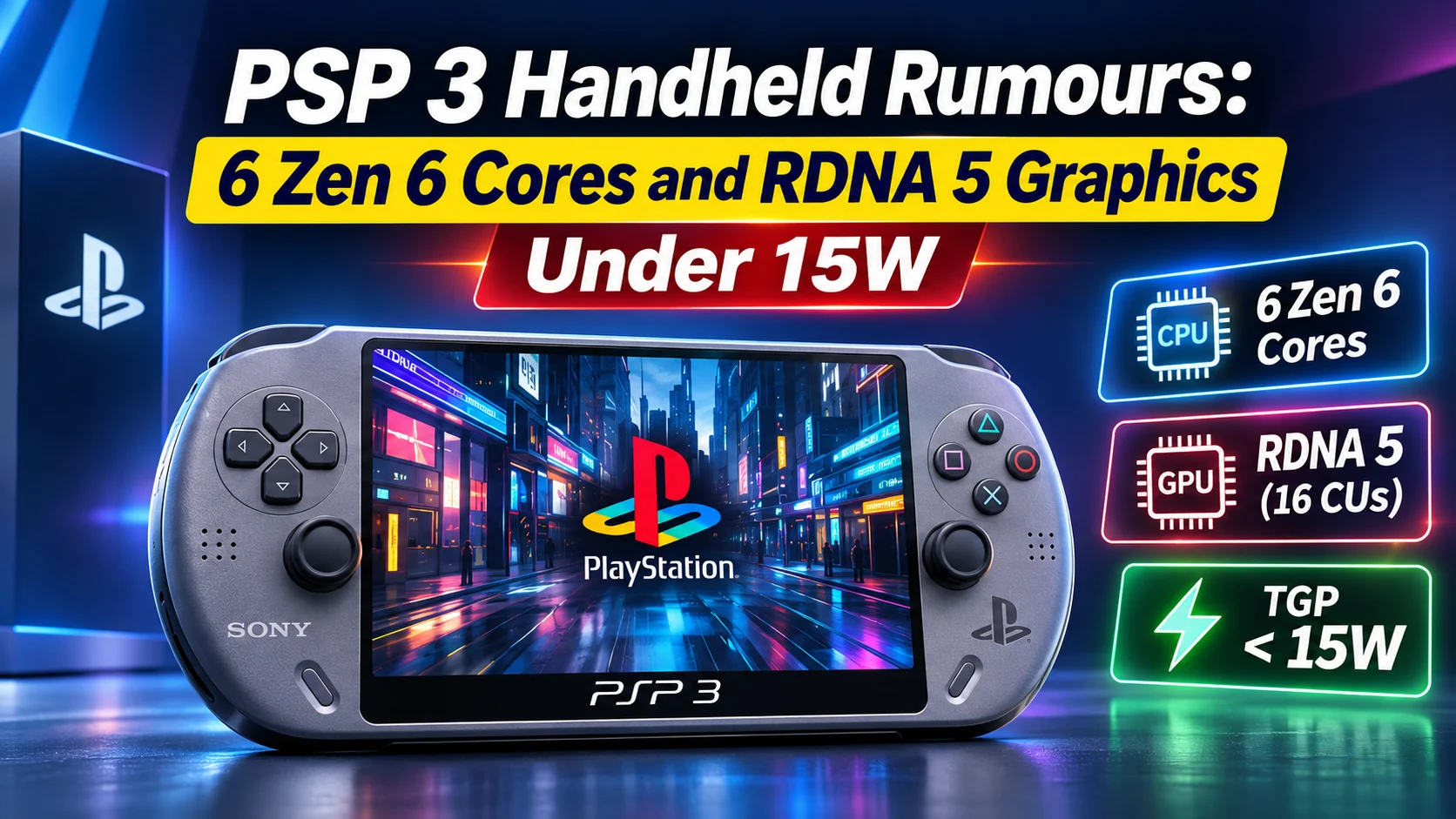

The PSP 3 Handheld Rumours could mark Sony’s exciting return to portable gaming, with rumours suggesting a powerful yet energy-efficient gaming device. Reportedly featuring six AMD Zen 6 CPU cores and 16 RDNA 5 compute units, this rumoured handheld could deliver impressive gaming performance in a compact design. If these specifications prove accurate, it could offer a compelling combination of processing power, advanced graphics, and console-style gaming on the go.
One of the most interesting reported features is a thermal graphics power (TGP) below 15W. Such a low power target could help improve battery life, reduce heat generation, and minimise cooling requirements while maintaining enjoyable gameplay. However, actual performance would depend on clock speeds, memory bandwidth, cooling design, and software optimisation. The combination of AMD’s rumoured next-generation architecture and an efficient power profile could make the PSP 3 Handheld an interesting prospect for gamers seeking portable performance without excessive power consumption.
However, Sony has not officially confirmed the PSP 3 Handheld or its reported specifications. The six Zen 6 CPU cores, 16 RDNA 5 compute units, and sub-15W TGP should therefore be treated as rumours rather than facts. Pricing, release date, battery capacity, and game compatibility also remain unconfirmed. Until Sony shares official details, these reports offer an intriguing glimpse into what a future PlayStation handheld might deliver, rather than a guarantee of its final capabilities.
Table of Contents
1: PSP 3 Handheld Rumours Specifications: Expected Hardware at a Glance
| Specification | Rumored Details |
|---|---|
| Device | Sony PSP 3 Handheld |
| CPU Architecture | AMD Zen 6 |
| CPU Cores | 6 cores |
| GPU Architecture | AMD RDNA 5 |
| GPU Compute Units | 16 CUs |
| Power Target | Below 15W TGP |
| Upscaling Technology | Potential hardware-assisted upscaling |
| Memory | Not officially confirmed |
| Storage | Not officially confirmed |
| Display | Not officially confirmed |
| Operating System | Not officially confirmed |
| Release Date | Not announced |
| Expected Price | Not announced |
2: Six AMD Zen 6 CPU Cores: What Could They Mean for Gaming?
The rumoured PSP 3 Handheld could feature six AMD Zen 6 CPU cores, potentially delivering the processing power needed for demanding portable gaming. A modern CPU handles essential workloads such as game logic, physics calculations, character behaviour, and system operations, helping games run smoothly while keeping background tasks responsive.
With six cores, the handheld could balance demanding AAA games with operating-system processes and other background workloads. CPU-intensive titles featuring large open worlds, complex simulations, and numerous non-player characters could benefit from efficient multithreaded performance. However, the number of cores alone does not guarantee higher frame rates.
Actual performance would depend on clock speeds, cache capacity, power limits, and thermal management. Maintaining strong performance within the rumoured sub-15W power target could require careful optimisation. Since Sony has not confirmed these specifications, the Zen 6 configuration remains speculative rather than an established feature.
3: Expected Gaming Performance: Can PSP 3 Run AAA Games?
The PSP 3 Handheld could offer versatile gaming performance if its rumoured six AMD Zen 6 CPU cores and 16 RDNA 5 compute units become reality. Competitive games could benefit from responsive controls and stable frame rates with suitable graphics settings, while indie titles may run efficiently and help extend battery life.
Older PlayStation games could also be a major attraction, depending on Sony’s compatibility support and software design. For modern AAA games, performance would depend on resolution, graphics settings, game optimisation, and potential upscaling technology.
Demanding open-world games present a greater challenge, as complex environments and detailed visuals require substantial processing power. Maintaining consistent frame rates within a rumoured sub-15W power target would require careful optimisation. Actual gaming performance remains unconfirmed, as Sony has not officially announced the PSP 3 Handheld or its specifications.
4: PSP 3 Handheld vs ASUS ROG Ally X
| Feature | Rumoured PSP 3 Handheld | ASUS ROG Ally X |
|---|---|---|
| Processor | 6-core AMD Zen 6, rumoured | AMD Ryzen Z1 Extreme |
| Graphics | 16 RDNA 5 CUs, rumoured | AMD RDNA 3 graphics |
| Power Target | Below 15W, reported | Configurable operating power |
| Operating System | Unconfirmed | Windows 11 |
| Game Compatibility | Unconfirmed | PC games and supported emulation software |
| Battery Life | Unknown | Depends on workload and settings |
| Price | Unannounced | Varies by market and configuration |
5: Sony’s Potential Handheld Gaming Strategy
Sony could consider developing a dedicated portable gaming device to bring its PlayStation gaming experience to players beyond the living room. A rumoured PSP 3 Handheld could offer an opportunity to combine portable hardware with games optimised specifically for Sony’s ecosystem. However, the company has not officially confirmed this device or its features.
Closer integration between hardware, the operating system, and PlayStation games could improve performance consistency, simplify controls, and help developers optimise their titles. Access to digital game libraries, cloud gaming, and cross-platform features could also increase convenience, provided Sony supports them.
A new handheld could complement PlayStation consoles rather than replace them, giving players another way to enjoy gaming. Its actual role will depend on Sony’s confirmed plans, compatibility policies, and software support.
6: Expected Battery Life, Cooling, and Design
The rumoured PSP 3 Handheld could prioritise power efficiency, comfortable controls, and reliable cooling for portable gaming. However, its actual design and battery performance remain unconfirmed.
- Power Efficiency: A rumoured sub-15W graphics power target could reduce heat output and help the device operate efficiently during gaming.
- Battery Life: Gaming endurance will depend on battery capacity, CPU and GPU workloads, display brightness, and total system power consumption.
- Cooling System: An effective cooling solution would be essential to manage heat and maintain consistent performance during demanding gaming sessions.
- Ergonomics and Weight: Comfortable grips, balanced weight distribution, and well-positioned buttons could improve the experience during extended play.
- Display and Controls: Screen size, resolution, refresh rate, and responsive controls would influence visual quality and overall usability.
- Heat Management: Proper ventilation and thermal design would help prevent excessive temperatures around the grips.
Ultimately, TGP alone cannot determine battery life. Sony has not confirmed the PSP 3 Handheld’s battery capacity, dimensions, cooling system, or design.
7: What We Want to See From the PSP 3 Handheld
For the PSP 3 Handheld to stand out in the portable gaming market, it needs more than powerful hardware. Here are the key features we would like Sony to prioritise:
- Efficient Performance: Deliver smooth gameplay while maintaining the rumoured low-power target.
- Strong Battery Life: Provide several hours of practical gaming, including during demanding titles.
- Comfortable Design: Offer ergonomic grips, responsive buttons, and well-positioned controls for extended sessions.
- High-Quality Display: Deliver sharp visuals, vibrant colours, and smooth motion.
- PlayStation Compatibility: Support a compelling range of modern PlayStation games through a clearly defined compatibility strategy.
- Effective Cooling: Maintain stable performance without excessive fan noise or uncomfortable heat.
- Competitive Pricing: Offer good value against Windows handhelds and other gaming devices.
- Long-Term Support: Provide reliable software updates, security improvements, and a strong game library.
Ultimately, Sony’s success would depend on balancing performance, portability, affordability, and long-term usability.
8: Frequently Asked Questions (FAQs)
Q1: What are the rumoured specifications of the PSP 3 Handheld?
The rumoured PSP 3 Handheld could feature six AMD Zen 6 CPU cores, 16 RDNA 5 GPU compute units, and a graphics power target below 15W. Sony has not confirmed these specifications.
Q2: Will the PSP 3 Handheld use AMD Zen 6?
The report suggests a six-core AMD Zen 6 processor. However, the final processor and hardware configuration remain unconfirmed.
Q3: How powerful is a 16-CU RDNA 5 GPU?
Its performance would depend on clock speeds, memory bandwidth, architecture, power limits, and software optimisation. Compute-unit count alone cannot predict gaming performance.
Q4: Can the PSP 3 Handheld run AAA games?
Potentially, but performance and compatibility would depend on the final hardware, game optimisation, resolution, and graphics settings.
Q5: Will the PSP 3 Handheld have better battery life?
A low graphics power target could improve efficiency. However, battery capacity, display power consumption, CPU workload, and cooling also affect battery life.
Q6. When will the PSP 3 Handheld launch?
There is no officially confirmed release date. Sony has not announced the device’s launch schedule, pricing, or availability. Follow official PlayStation announcements for verified updates.
9: Conclusion
The rumoured PSP 3 Handheld could become an exciting addition to portable gaming if it combines six AMD Zen 6 CPU cores, 16 RDNA 5 GPU compute units, and a graphics power target below 15W. This combination could prioritise efficient performance, reduced heat output, and a more convenient handheld gaming experience.
However, power efficiency alone will not guarantee success. Real-world gaming performance, battery life, PlayStation game compatibility, cooling, and competitive pricing will ultimately determine its appeal. While these reported specifications sound promising, Sony has not officially confirmed the PSP 3 Handheld or its hardware details. Until reliable information becomes available, treat these specifications as rumours rather than final product features.