
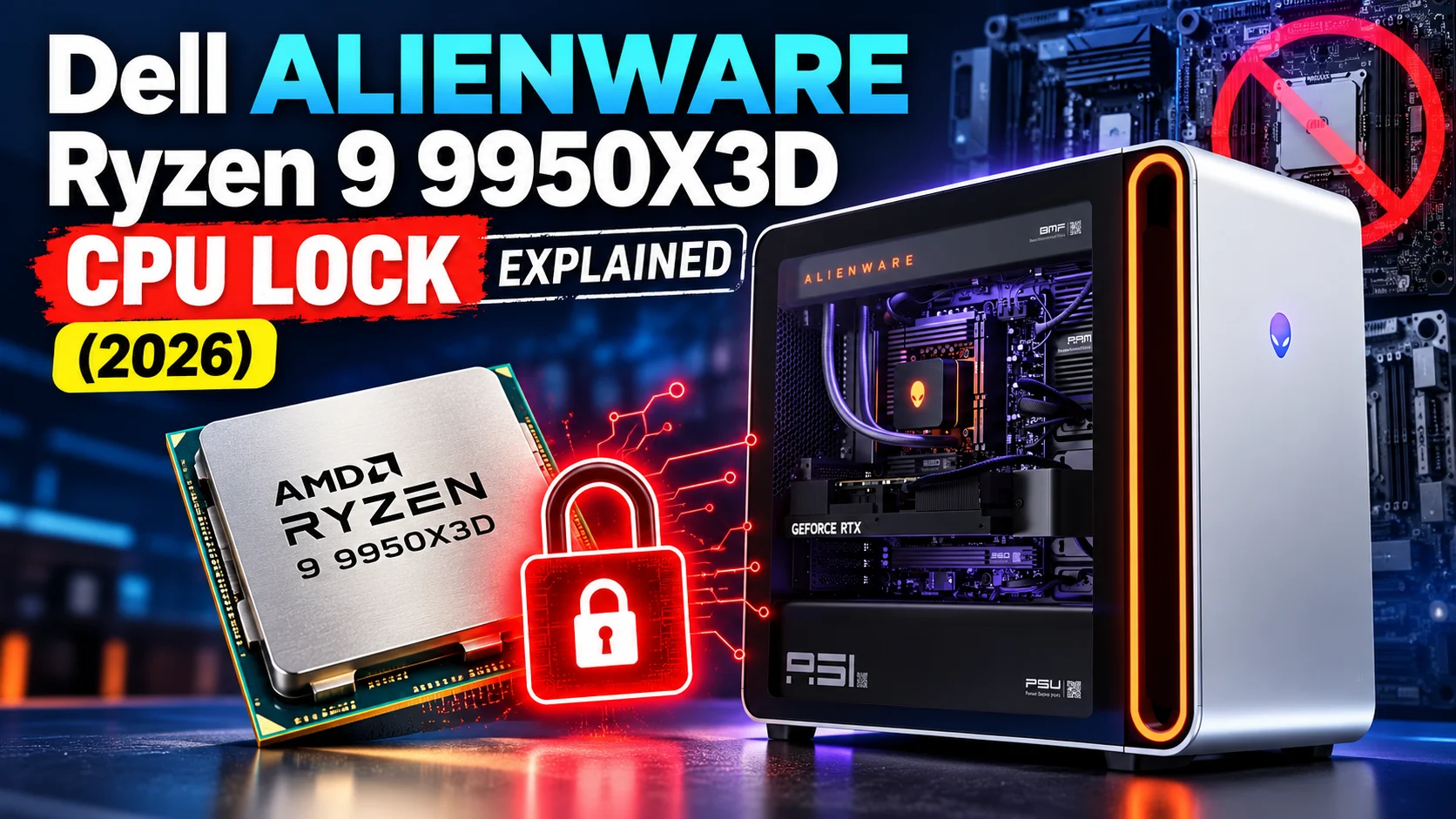

The Dell Alienware Ryzen 9 Locked CPU controversy has raised concerns about hardware compatibility and upgrade flexibility in expensive prebuilt gaming PCs. The issue involves an AMD Ryzen 9 9950X3D processor reportedly taken from an Alienware Area-51 desktop that allegedly failed to work after being installed on another motherboard.
The incident has raised important questions about AMD Platform Secure Boot (PSB), component reuse, repairability, and second-hand resale value. If a processor is bound to an OEM platform through firmware security mechanisms, transferring it to a compatible third-party motherboard may not work as expected.
However, this remains a reported user experience, not proof that every Ryzen 9 9950X3D is locked to Alienware motherboards. Understanding the exact hardware configuration and firmware requirements is essential before drawing conclusions or attempting an upgrade.
Table of Contents
1: What Is AMD Platform Secure Boot (PSB)?
The Dell Alienware Ryzen 9 locked CPU Lock incident gained attention after an owner reported that their AMD Ryzen 9 9950X3D processor failed to boot on other motherboards after they removed it from the prebuilt desktop.
The owner reportedly purchased the Alienware Area-51 and later attempted to reuse the CPU in a custom-built PC. After unsuccessful motherboard compatibility tests, the owner shared the issue on Reddit, raising concerns about Dell’s firmware restrictions and CPU portability.
AMD Platform Secure Boot (PSB) may explain this because it can bind a processor to an OEM’s firmware-signing key. Dell’s service documentation references PSB requirements for third-party AMD motherboard conversions.
However, the owner’s reported experience should not be treated as independent proof that every Alienware Ryzen processor is locked or that the restriction is irreversible.
2: Dell Alienware Area-51: Key Specifications
| Component | Key specifications |
|---|---|
| Processor | AMD Ryzen 9 9950X3D |
| CPU cores | 16 |
| Total cache | 144MB |
| Graphics | NVIDIA GeForce RTX 5080 or RTX 5090, depending on configuration |
| Memory | 32GB or 64GB DDR5 |
| Storage | 1TB or 2TB SSD, depending on configuration |
| Motherboard platform | AMD X870E |
| CPU cooling | 360mm liquid cooling |
3: How Does CPU Vendor Locking Work?
CPU vendor locking is a firmware restriction that may prevent a processor from working outside its original OEM platform.
- AMD Platform Secure Boot (PSB): Can bind a CPU to an OEM’s firmware-signing key, potentially restricting compatible firmware.
- BIOS compatibility: The motherboard BIOS must support the processor.
- CPU initialisation: Firmware, memory, power delivery and hardware compatibility all affect startup.
- Socket compatibility: A CPU may physically fit an AM5 motherboard but still fail to boot because of firmware restrictions.
A failed boot alone does not prove CPU locking. BIOS incompatibility, faulty components, or memory issues can cause similar symptoms. Confirming PSB-related locking requires additional technical evidence.
4: What Happens If You Install the Ryzen 9 9950X3D in Another Motherboard?
The Ryzen 9 9950X3D reportedly failed to boot on alternative motherboards after removal from a Dell Alienware Area-51 desktop.
- Socket compatibility: The CPU uses AMD’s AM5 socket, but a matching socket does not guarantee compatibility.
- Possible symptoms: Failed POST, a black screen or a motherboard CPU error indicator.
- BIOS updates: Updates may fix compatibility issues, but may not overcome a confirmed hardware-enforced security restriction.
These symptoms do not prove CPU locking. Not every third-party motherboard or Alienware configuration has been tested, so verify compatibility before transferring the processor.
5: Can You Unlock or Reuse a Dell-Locked Ryzen 9 9950X3D?
Reusing a Dell Alienware Area-51’s Ryzen 9 9950X3D processor in a custom PC may be difficult if AMD Platform Secure Boot (PSB) has been configured to bind the CPU to an OEM’s firmware-signing key.
Can the CPU Lock Be Removed?
- Hardware-enforced restrictions: If a security configuration is stored in one-time-programmable hardware, it may not be reversible through ordinary software changes.
- BIOS flashing: Installing a different BIOS may not remove a processor-level restriction because the security configuration may reside within the CPU.
- Configuration checks: Confirm the exact processor, motherboard model and BIOS version before attempting repairs.
AMD PSB can impose OEM firmware restrictions, but the precise configuration and reversibility of the reported Alienware Area-51 incident have not been independently established. Do not assume the CPU is permanently locked without further technical evidence.
6: What Should Buyers Check Before Purchasing an Alienware Desktop?
Before buying an Alienware desktop, consider these important factors:
- CPU Compatibility: Confirm whether the processor can work with another compatible motherboard.
- Motherboard Upgrades: Check replacement options, BIOS support and component compatibility.
- Warranty and Repairs: Review warranty coverage and repair costs.
- CPU Locking: Ask Dell about permanent CPU-to-platform security restrictions.
- Future Upgrades: Consider component reuse and resale value.
- Price Comparison: Compare Alienware’s price with a custom-built PC offering similar specifications.
Confirm CPU portability and motherboard replacement options with Dell before purchasing if future upgrades are important to you.
7: Frequently Asked Questions (FAQs)
Q1: Why is the Dell Alienware Ryzen 9 9950X3D reportedly locked?
An Alienware Area-51 owner reported that the Ryzen 9 9950X3D failed to boot on alternative motherboards. AMD Platform Secure Boot (PSB) is a possible explanation, but the exact cause requires independent verification.
Q2: What is AMD Platform Secure Boot?
AMD Platform Secure Boot is a firmware security mechanism that can bind a processor to an OEM’s firmware-signing key, potentially restricting its use with other motherboard platforms.
Q3: Can I install an Alienware Ryzen 9 9950X3D in an ASUS or MSI motherboard?
The processor uses the AM5 socket, but physical compatibility does not guarantee successful operation. BIOS support, firmware configuration and any PSB restrictions must also be considered.
Q4: Can a BIOS update remove the Dell CPU lock?
A BIOS update may fix ordinary compatibility issues, but it may not remove a hardware-enforced security restriction. Confirm the cause before attempting firmware changes.
Q5: Does the CPU lock affect performance?
A firmware restriction does not necessarily reduce CPU performance in the original supported system. Its main potential impact is hardware portability and upgrade flexibility.
Q6: Can a locked Ryzen processor be resold?
Potentially, yes. However, a processor restricted to a particular OEM platform may have a smaller buyer pool and lower resale value. Disclose any known restrictions and verify compatibility before selling.
8: Conclusion
The Dell Alienware Ryzen 9 Locked CPU controversy raises important questions about processor security, motherboard compatibility, and hardware ownership. Reports suggest that AMD Platform Secure Boot (PSB) may prevent the Ryzen 9 9950X3D from booting on certain non-Alienware motherboards.
While firmware security can protect system integrity, restrictions on reusing expensive components may limit repairability, upgrades, and resale value.
However, the exact mechanism behind this specific incident requires further technical verification. Before purchasing an Alienware desktop, confirm CPU compatibility, motherboard replacement options, warranty coverage, and upgrade limitations directly with Dell.
Alienware desktops can deliver powerful gaming performance, but buyers should understand potential hardware restrictions before investing in a premium prebuilt system.
Also Read: